
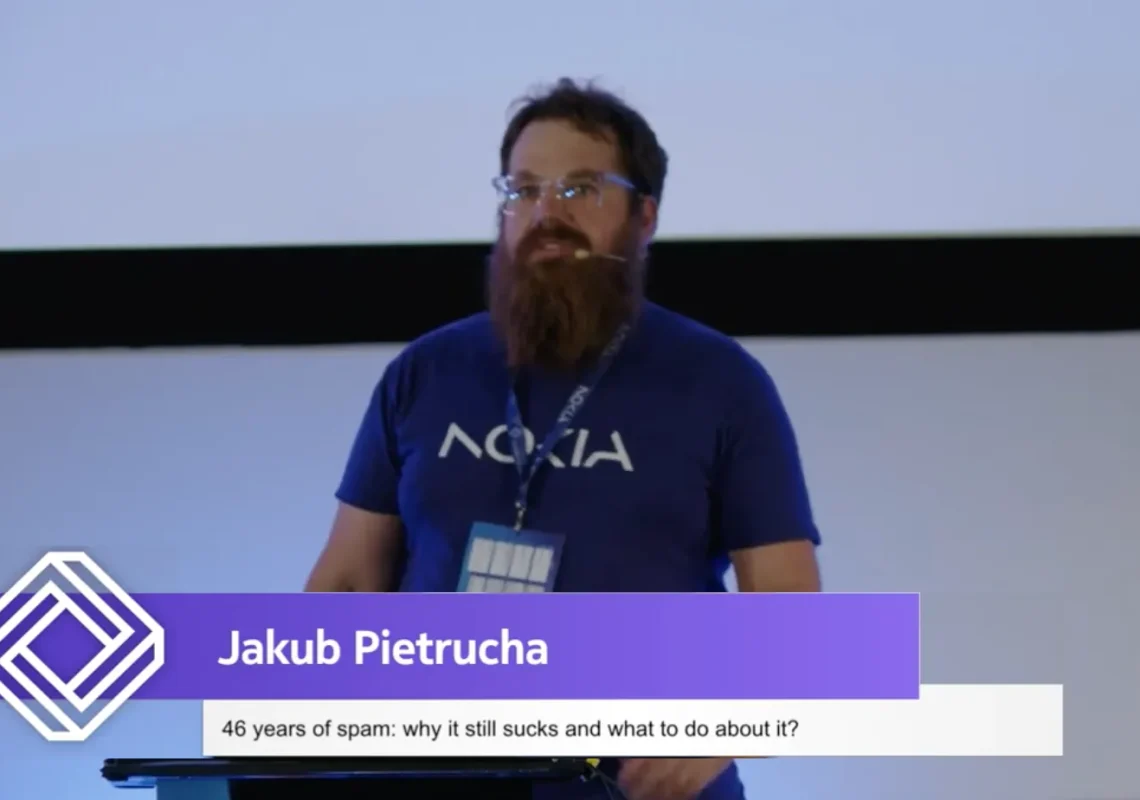
On October 12, Jakub, one of our co-founders, took the stage at code::dive 2025, one of Europe’s leading programming conferences. His talk on “SPAM” tackled a problem every developer and founder knows all too well. Instead of only dry theory, he approached the topic with humor, sharp observations, and practical advice you can actually apply. Below, you’ll find the full conference video and transcript.
What is code::dive?
code::dive is an annual, open-to-all software development conference organized by Nokia in Wrocław since 2014. It is widely recognized as one of the largest C++-focused conferences in the world and a major tech event in Europe.
The 12th edition, held in October 2025 in Wrocław, featured expert talks on modern C++, software safety and security, embedded systems, artificial intelligence, and cross-language engineering practices. The conference combines deep technical content with real-world case studies and discussions on practical developer skills.
With free attendance, a strong engineering community, and recorded sessions available online, code::dive continues to promote accessible, high-quality knowledge sharing for developers worldwide.
The presentation video and transcript
The presentation begins by addressing whether the audience has ever received B2B sales emails, setting the stage to discuss the 46-year history of spam, how to dissect the perfect spam email, and modern tools to fight it.
The term "spam" originated from an American company trying to boost sales of its spicy ham, which was a popular food for World War II soldiers. The word's modern meaning migrated from a Monty Python sketch where Vikings in a cafe sang "spam" repeatedly, which was as annoying as unwanted emails.
In 1978, Gary Thuerk sent the first sales email over ARPANET, making $20 million in sales and starting the escalation of the practice. By 1991, the World Wide Web was born, and spam became so prevalent that President Bush signed the CAN-SPAM Act in 2003, though it did not stop the problem. In 2004, Bill Gates predicted spam would soon be a thing of the past, but he proved to be a better businessman than a prophet.
The history of spam also includes the sentencing of an Australian man for Nigerian spam and the death of Vardan Kushner, a man famous for spamming Russian speakers. Modern spammers often use the "noble" term "cold email" and claim that distributing spam is a "meta skill".
A perfect spam email relies on a compelling subject line that takes cultural context into account,. It typically includes a personalized compliment to keep the recipient reading, followed by a pitch—such as a Nigerian prince in need—and a call to action, like transferring bitcoins.
Technical defenses include Gmail headers like SPF, which lists allowed servers in a DNS record, and DKIM, which provides a digital signature to prevent email spoofing.
Paul Graham, the co-founder of YC, attempted to end spam by using AI-like tokenization to calculate the probability of an email being spam based on its content. This was effective because most emails are either clearly spam or clearly legitimate, with very few in the gray zone.
Modern email management tools have also emerged, such as Hey mail, which uses a screener to block new domains and tracking pixels, or Superhuman, which uses AI features and keyboard shortcuts to help users sort through emails quickly.
A more advanced personal workflow involves treating every email as unwanted by default. This system uses a whitelist for trusted contacts and a Python script powered by an LLM (Large Language Model) to process the rest. The LLM assigns a score from zero to ten based on a custom prompt; emails scoring five or higher are sent to a "dumpster email" folder. This allows the user to build a personal spam corpus while receiving a summary of discarded emails via Slack. This process is cost-effective, potentially costing only $10 a year for 10,000 emails.
Ultimately, what qualifies as spam is personal, and it is important for individuals to be the owners of their own filters to maintain control. While there is no ultimate solution and some collateral damage—such as missing an important email or receiving a bit of spam—is inevitable, the resulting peace of mind is worth it.
The talk concludes with the fun fact that in Hawaii, sushi with spam is considered a delicacy.

